TIBETAN RESETTLEMENT PROJECT
- BAFOT
- May 3
- 6 min read
Bay Area Friends of Tibet · 1991–1993

New York Times coverage announcing the 1990 Immigration Act provision for 1,000 Tibetans
A Door Opens
In 1990, a historic provision tucked into the U.S. Immigration Act offered something Tibetan refugees had almost stopped hoping for: a path to America. One thousand visas — no government funding, no refugee benefits for three years — just a notarized job offer and a sponsor willing to say: we will take care of you.
Washington had long been reluctant to grant Tibetans refugee status, wary of provoking Beijing. China had claimed sovereignty over Tibet since its military occupation in 1950, and in the thirty years prior, only about 500 Tibetans had entered the United States. The new law, introduced by Representative Barney Frank of Massachusetts, did not use the word "refugee" at all — but it opened the door.
The Bay Area Friends of Tibet, a small advocacy organization, stepped up. With roughly 50 Tibetans already living in the Bay Area, they accepted responsibility for resettling 100 of the 1,000 allocated immigrants. What followed was a two-year effort fueled entirely by volunteers, donors, sympathetic employers, and the Tibetan community itself.
The Story in the Press
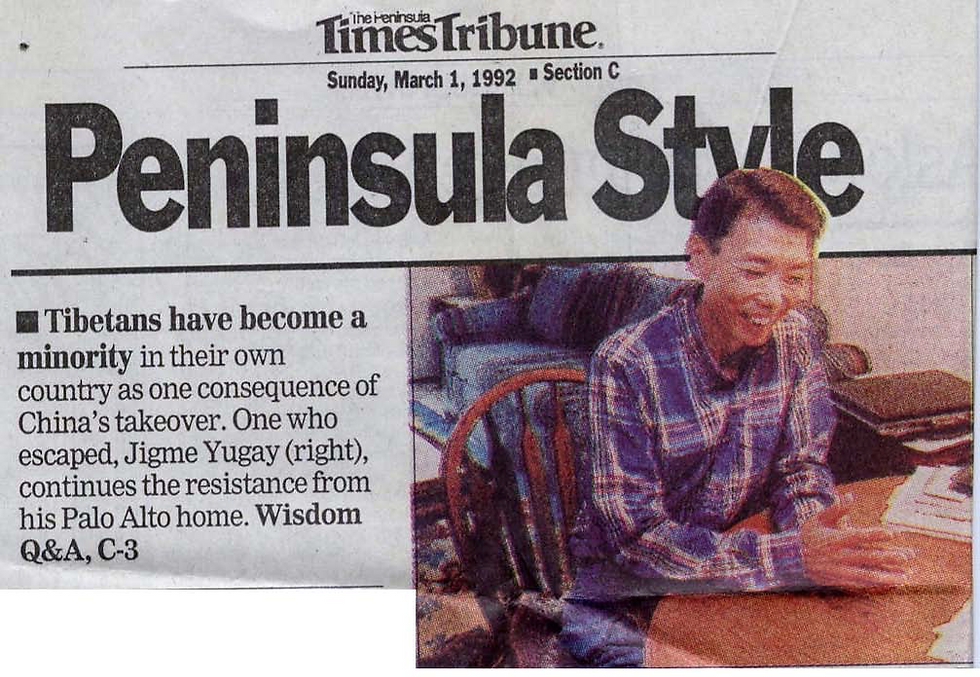
Peninsula Times Tribune, March 1, 1992 — Jigme Yugay, co-founder of Bay Area Friends of Tibet, pictured at his Palo Alto home
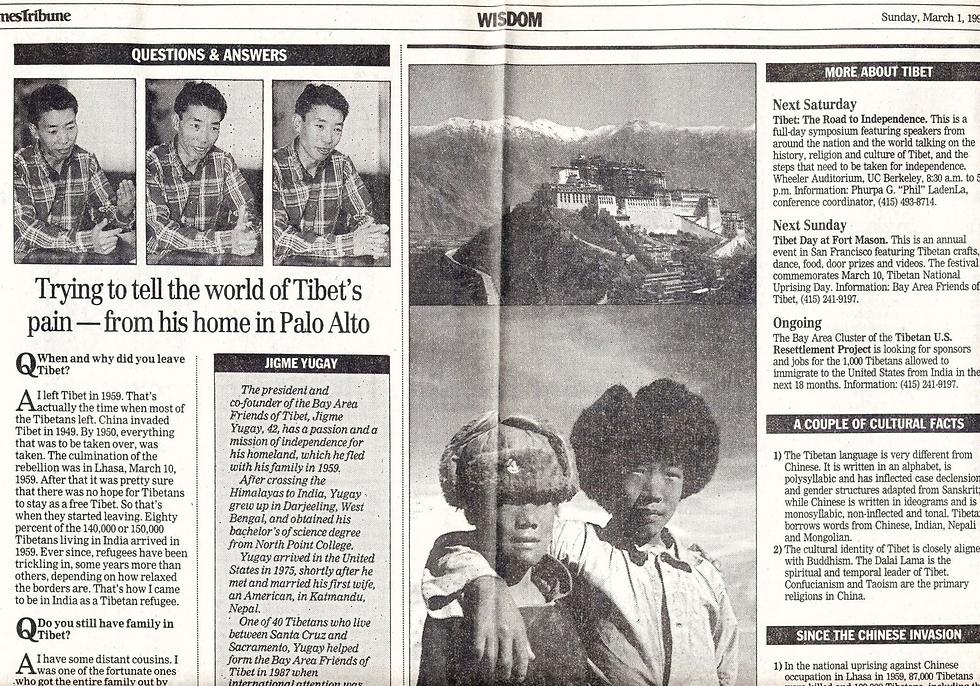
"Trying to tell the world of Tibet's pain — from his home in Palo Alto." The Times Tribune Q&A with Jigme Yugay, 1992
The Law That Changed Everything
Under the 1990 Immigration Act, 1,000 visas were made available to "qualified displaced Tibetans" — natives of Tibet, their children and grandchildren who had been living continuously in India or Nepal. The Tibetans would receive permanent residence and work authorization, but no federal benefits for three years. Each applicant needed a notarized job offer letter and a notarized sponsor letter — placing the entire burden of resettlement on private citizens and community organizations. The program had a 1993 completion date.
Immigrants would be grouped at ten sites around the country including New York City, San Francisco, Minneapolis, Madison, Ithaca, and Amherst. The Bay Area cluster aimed to bring 100 Tibetans to the peninsula and East Bay.

"In Search of Sanctuary by the Bay" — San Francisco Examiner coverage of Tibetan refugees arriving in the Bay Area
The People Behind the Project
The steering committee drove the effort: Phurpa (Phil) Ladenla, Ed Lazar, Saundra McPherson, Kim Morris, Fred and Julia Shepardson, and Jigme Yugay. They were supported by an advisory board that included Joan Baez, Senator Dianne Feinstein, Congressman Tom Lantos, David Brower, Ram Dass, Galen Rowell, and Tibetan spiritual leaders Lama Kunga Rinpoche and Lama Tharchin Rinpoche.

East Side Story — Lama Kunga Rinpoche, who fled Tibet in 1959 and founded the Ewam Choden Tibetan Buddhist Center in Kensington
"Once Tibetan civilization was good like seedlings. It sprouted out and rooted well. I think it will grow again when Tibetans spread like seedlings on a global scale." — Lama Kunga Rinpoche

Julia and Fred Shepardson of Portola Valley — Country Almanac, February 1992. Julia served as project coordinator; Fred headed the employment committee.
Raising the Resources
With no government funds available, the project raised money through high-profile events and foundation grants. Benefit events included a Philip Glass concert, a film festival at the Castro Theater, an evening at the Metropolitan Club, Tibet Day in Santa Cruz, and lectures across the peninsula.
Foundation support came from the Koret Foundation, the Jewish Community Endowment, the American Himalayan Foundation, the Fred Gellert Foundation, the San Francisco Foundation, and the Palo Alto Kiwanis Club.
Finding Jobs in a New Land
Every immigrant required a notarized job offer before they could receive a visa — which meant the project had to secure employment commitments in advance. Fred Shepardson led the employment committee, reaching out to small businesses and appealing to larger companies. Employers who opened their doors included:
Chez Panisse · Hyatt Hotels · Alza Corporation · Zia Cosmetics · Zachary's Chicago Pizza · REI · The Grateful Dead Ticket Office · Monterey Market · John Muir Hospital · Stars Restaurant · Whole Earth Access · Hillcrest School · Cliff's Variety · The Stratford · Salem Home · Nut Tree · The Art Peddler · MussiArt · Gitane Painting · Wellex · Brilliant Color Cards

"Tibetans Leave Himalayas For New Beginnings in US" — India-West. The first batch of 27 Tibetan immigrants settled in the Bay Area.
Arriving: New Lives, New Stories
The first wave of Bay Area arrivals included Tsultrim Dolma, a former Tibetan schoolteacher who had taught in Dharamsala for eleven years. She arrived in Oakland and found work as a housekeeper at the Hyatt Regency. Dhondup Tsering, a 35-year-old, meditated daily in a small room in Kensington before an altar bearing pictures of the Dalai Lama and Lord Buddha — while living in the home of his American sponsors.

"Tibetans Adapt to Life in Bay Area" — San Francisco Examiner / Chronicle. "Tibet Refugees Get New Home in Bay Area — 7 to arrive today under special immigration status."

West County Times, May 25, 1992 — Dhondup Tsering meditates before an altar in his temporary home in Kensington
"We have freedom here. You don't have to fear what you say here." — Karma Tenzin, Tibetan immigrant

Half Moon Bay Review, February 1993 — "Tibetan Dorji Describes His Goals." Tamdin Dorji arrived after a 22-hour flight via Tokyo, found construction work, then a grocery job in Oakland.

"Hope Incarnate — Despite hardships, Tibetans embrace life in a new land." Vintul Rinpoche, proclaimed an incarnate lama at 8 months old, came to the U.S. in January.
New Lives in Northern California

Sacramento Bee, October 9, 1992 — "Despite Tibet's pull, they build new lives in north state." Tagudh Youngdoung, Lobsang Dharchen and Tashi Samdup settled in Vacaville, working at a pharmaceutical factory.

"Sad Memories of Home" — Tsewang Youngdoung can't forget the way the Chinese have treated the Tibetan people.

"Tibetan Immigrants Make a New Life in U.S." Vacaville. "We have freedom here," said Karma Tenzin. "You don't have to fear what you say here."
The Volunteer Network
Behind every immigrant was a web of volunteer support. Sponsors provided housing for the critical first three months — required since the Tibetans were ineligible for welfare benefits in their early years. Tutors taught English and computer skills. Nurses and doctors offered pro-bono care. Airport volunteers were on hand for every arrival. The "clustering" approach — resettling members of the same community in geographic proximity — helped immigrants support each other through the adjustment.
Dedicated volunteers included: Chaksampa, Nancy Ableser, Gyalden Yuthok, Jeanne Herbert, Christine Schneider, Lama Kunga Rinpoche, Saundra McPherson, Tashi Norbu, Cyndie Zikmund, Barbara Kosner, Nora Sage Murray, Tara Sullivan, Nancy Nielsen RN, Dr. Marc Leiberman, Jamyang Lama, Nancy Harris MD, Barry & Nancy Weavers, Jamyang Singe, Greg Alling, Joseph Terbitian, Lionel Biron, and many others.

Tibetan immigrants and project volunteers at San Francisco International Airport — the Tibetan national flag held proudly as new arrivals land for the first time in the United States
Sponsors — Families Who Opened Their Homes
Nancy Ableser · Ellen & Robert Ansel · Fadhilla Bradley (3) · Margo Brumme · Carol Fields (2) · Dianna Goodman · Lucille Green · James Harder (3) · Lobsang Gyaltsen (2) · Mark & Elizabeth Henderson · Jeanne & Herbie Herbert (2) · Eva Herzer · David & Barbara Hunt · Bill & Dolma Kane · Jamyang Lama · Patti & Lyle Larson · Melanie & Marc Lewart · Dianne Libero · Henry & Linda McHenry · Bonnie Mintun & Tim Hoban · Lucas Myers (2) · George Nandor · Jan Potts (2) · Liz Rezner & Bennett Dubiner (2) · Thomas Rosin & Gail Wread · Denny Sargent · Alan & Laurie Senauke (2) · Steven Sklar & Sharon Pollack · Fred & Julia Shepardson · Kendra & Huston Smith (3) · Susan Sopcak & Bob Spence (2) · David Spitzer · Pastor Ross Merkel — St. Paul Lutheran (5) · Francis St. Amant & Nancy McClure · Carol Sundell · Marc & Tsewang Tatz (2) · Jan Tiura & Joe Brennan (2) · Lisa Tracy · Margo & Gordon Tyndall (2) · Judy Weitzner · Cindy Zikmund & Dave McMahan
Community — August 21, 1993
By the summer of 1993 — the program's final year — Bay Area Tibetans had formed a genuine community. This photograph, taken August 21, 1993, shows dozens of Tibetan immigrants and their American supporters gathered together: the tangible result of two years of extraordinary collective effort.

Bay Area Tibetan community and supporters, August 21, 1993 — the community the resettlement project built
A Legacy of Refuge
The Tibetan U.S. Resettlement Project closed in 1993 having demonstrated something remarkable: a small, motivated community organization could accomplish what government programs would not attempt — and it did so by building genuine human relationships between Tibetan immigrants and Bay Area residents.
Many of those who arrived between 1992 and 1993 are still in the Bay Area today, part of the Tibetan diaspora that Lama Kunga Rimpoche once compared to seedlings — scattered by occupation, but rooted wherever they land, waiting to grow again.
Bay Area Friends of Tibet · Tibetan Resettlement Project · 1991–1993


Comments